
I already did an informal separation — can I fix it?
I already did an informal separation — can I fix it?
A Beyond Separation guide for Australians who reached an informal arrangement with their ex, transferred property, and now face a tax bill they weren't expecting.
A Beyond Separation guide for Australians who reached an informal arrangement with their ex, transferred property, and now face a tax bill they weren't expecting.
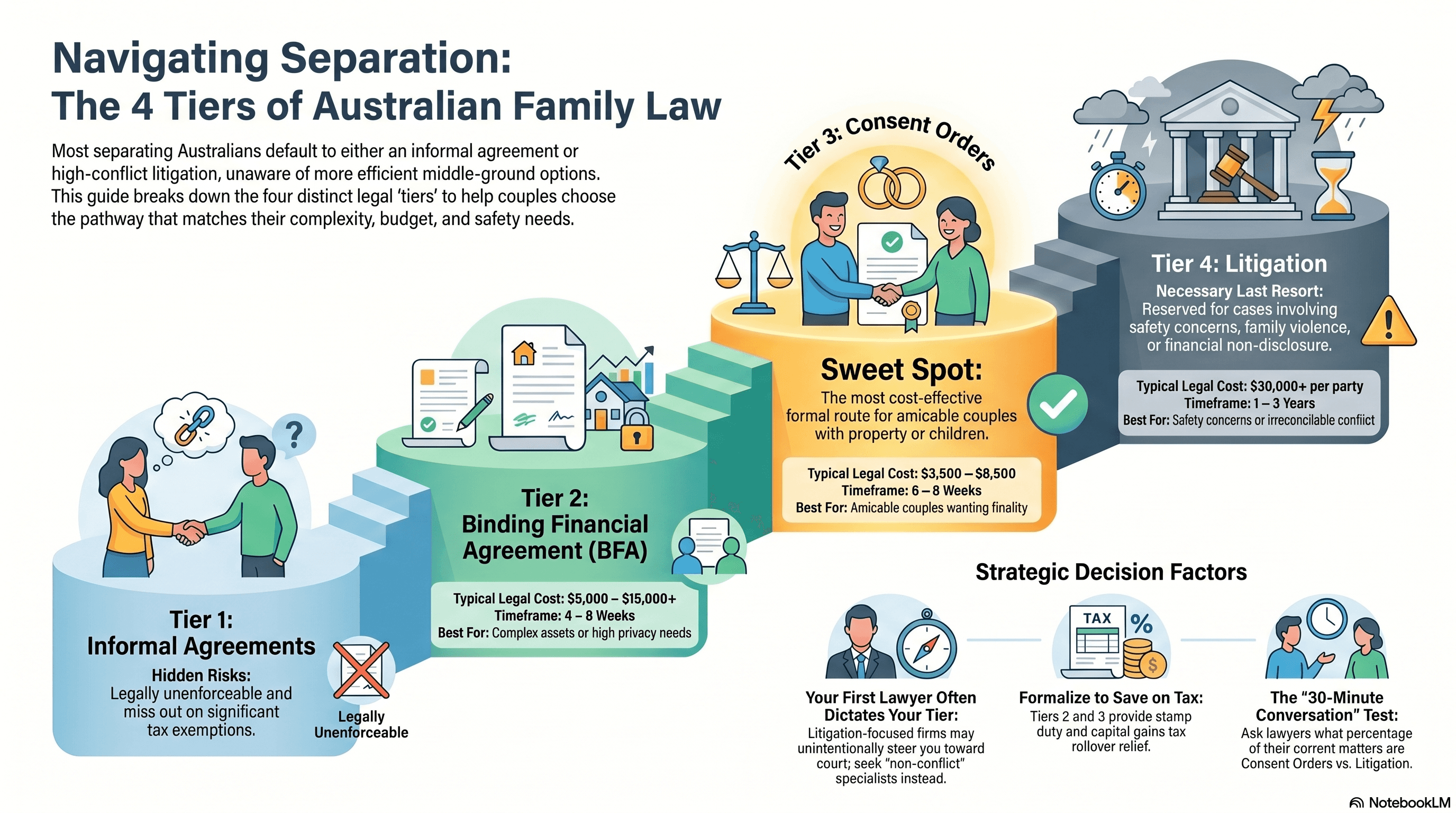
I already did an informal separation — can I fix it?
A Beyond Separation guide for Australians who reached an informal arrangement with their ex, transferred property, and now face a tax bill they weren't expecting.
Published April 2026. Approximate reading time: 12 minutes.
If you're reading this, you probably already know something's gone wrong. Maybe a stamp duty assessment arrived from Revenue NSW that you weren't expecting. Maybe your accountant flagged a capital gains tax event that you thought shouldn't have triggered. Maybe you transferred a property to your ex — or your ex transferred one to you — on the understanding that the separation was amicable and uncomplicated, and now, months later, the paperwork is catching up with you.
Here's what I can tell you from the outset: you are not the only one. The tax consequences of informal separation agreements are, by a significant margin, the most common and most expensive mistake made in the Australian separation market. Tens of thousands of Australian couples each year do roughly what you did — come to an agreement between themselves, transfer property or other assets, and move on with their lives, without ever formalising anything through the legal system. Almost none of them understand, at the time, that this decision will cost them tens of thousands of dollars in tax that they didn't need to pay.
The question you've arrived at this page asking is whether it can be fixed. The answer, for most of you, is partially yes. For some of you — particularly those in New South Wales — the fix is substantial and worth pursuing urgently. For others, the news is less good, and the honest thing to do is explain why so you can make an informed decision about what's actually recoverable versus what isn't.
This guide walks through both.
What usually went wrong
Before anything else, it's worth understanding what actually happened, in legal terms, when you and your ex made your informal arrangement. The reason this matters is that the fix depends entirely on the mechanics — and most people arrive at this page with a muddled understanding of which tax they've been hit with and why.
Here's what typically happens in an informal separation involving property.
You and your ex agree, between yourselves, how things will be split. You might write it down. You might not. You then proceed to actually transfer the asset — most commonly, one of you buys the other out of a shared family home, or a jointly held investment property is signed over to one party. A conveyancer handles the title transfer. The paperwork looks, on the surface, like any other property transaction.
And that's where the problem starts. Because in the absence of a court order or a Binding Financial Agreement, Australian tax law treats that transfer as any other property transaction between two people. The stamp duty exemption that applies to separating couples doesn't trigger. The capital gains tax rollover relief that applies to separating couples doesn't trigger. You've paid full tax on what could have been an exempt transfer, and neither of you knew it at the time.
There are three distinct tax consequences to be aware of, and they're often confused with each other. Keeping them separate is the first step to understanding what's recoverable.
Stamp duty (transfer duty). Paid by whoever received the property. If your ex transferred their half of the family home to you, and you paid stamp duty on the acquisition of their share, this is what the bill was for. Stamp duty is a state tax, which means the rules for fixing it vary dramatically depending on which state you're in.
Capital gains tax. Paid by whoever disposed of the property — the person giving up their share. If you transferred your half of a property to your ex and the ATO is now asking about a capital gain, this is what's being assessed. CGT is a federal tax. The rules are the same across Australia.
Main residence exemption. A federal provision that can exempt a property from capital gains tax if it was the main residence of one of the parties throughout the ownership period. This is separate from the CGT rollover relief — and depending on your circumstances, it might actually save you even if the rollover cannot.
Most people who have been "hit with a tax bill" after an informal separation have been hit with one of the first two, often both. Understanding which is which is the starting point.
The stamp duty question, state by state
Stamp duty — and its recoverability — is where the news is most variable. The state you live in determines almost everything about whether you can claw back what you've paid.
If you're in New South Wales
You're in the most forgiving jurisdiction in Australia. Under Section 68 of the Duties Act 1997 (NSW), the stamp duty exemption for property transfers between separating partners can be claimed retrospectively — meaning you can apply for a refund of stamp duty you've already paid, provided you subsequently obtain Consent Orders or a Binding Financial Agreement that covers the same transfer.
The practical steps, if you're in this situation, are:
Engage a family lawyer to draft Consent Orders that formally document the property settlement — including the transfer that has already occurred. This is technically retrospective documentation of what you did informally, structured to meet the Family Law Act requirements.
Lodge the Consent Orders with the Federal Circuit and Family Court of Australia for a registrar to seal.
Once sealed, submit Revenue NSW Form ODA 069 ("Application for Exemption or Refund — Break-up of a Marriage or De facto Relationship") along with the sealed orders.
If approved, Revenue NSW refunds the stamp duty you paid.
The time limit for this is generous but not unlimited. The stamp duty refund is available where the retrospective documentation is obtained within five years of the original transfer. The Family Law Act itself imposes a more immediate limit — you generally need to apply for Consent Orders within 12 months of a divorce order, or within 2 years of the end of a de facto relationship, although the court can grant leave in some circumstances to apply outside those windows.
For most NSW couples in this situation, the financial arithmetic is straightforward. On a typical Sydney property transfer, the stamp duty refund is in the region of $25,000 to $35,000. The cost of engaging a family lawyer to produce Consent Orders is typically $3,500 to $8,500. The return on the cost of fixing it is almost always an order of magnitude larger than the cost itself. If you're in this situation in NSW, pursuing the refund is almost certainly worthwhile.
If you're in Victoria
The news is harder. Victoria's stamp duty exemption under Section 44 of the Duties Act 2000 (VIC) requires the transfer itself to have been made "in accordance with" a sealed Consent Order or Binding Financial Agreement. Retrospective application — getting orders now to cover a past transfer — is much more difficult and often fails the "solely because of relationship breakdown" test that the State Revenue Office applies in practice.
This doesn't mean it's impossible. In some circumstances, a lawyer experienced in these matters can structure a case that establishes the original transfer was intrinsically connected to the relationship breakdown, and a sympathetic registrar may accept the application. But it's a narrower pathway than in NSW, and the success rate is materially lower.
If you're in Victoria and have paid stamp duty on an informal transfer, the honest answer is: get a consultation with a family lawyer experienced in retrospective matters before assuming it's recoverable, but also prepare yourself for the possibility that it isn't. The consultation itself is worth having — there are structures and situations where it does work — but don't budget on a refund until a lawyer has assessed your specific facts.
If you're in South Australia
South Australia has a unique provision that's worth knowing about. Under Section 71CB of the Stamp Duties Act 1923 (SA), a statutory declaration pathway exists for transfers of the former principal place of residence or a motor vehicle, even without formal Consent Orders or a BFA, provided the Commissioner is satisfied the relationship has broken down irretrievably.
This means that in SA, for the family home specifically, you may have a simpler route than the NSW approach — a statutory declaration confirming the breakdown, rather than a full Consent Orders application. For other property types (investment properties, commercial property, shares, business interests), you still need formal Consent Orders or a BFA, and the process becomes more similar to the NSW retrospective approach.
If you're in SA with a family home transfer, get advice on the statutory declaration pathway specifically — it's often faster and cheaper than obtaining Consent Orders.
If you're in Queensland, WA, ACT, NT, or Tasmania
Each has its own variation of the exemption, and each has its own rules about retrospective application. As a general rule, none are as generous as NSW, and the specifics depend heavily on the state. A consultation with a family lawyer familiar with your state's duties legislation is essential before assuming anything is or isn't recoverable.
The capital gains tax question
Here, the news is the same across Australia, and it's harder. The CGT rollover relief that applies to transfers between separating partners is set out in the federal tax law and requires, under ATO rules, that the transfer happen under a court order, a Binding Financial Agreement, or a similar formal instrument.
The ATO's position is explicit: the rollover does not apply if you and your spouse divided assets under a private or informal agreement. Once the transfer has occurred without formal documentation, the CGT event has crystallised. Subsequent documentation — even Consent Orders obtained months or years later — cannot generally retrospectively convert that event into a rollover-eligible transfer.
This is the hardest part of the picture to accept, and it's the part where well-meaning advice online often gets it wrong. If you transferred an investment property to your ex without a court order or BFA, and the ATO is now assessing capital gains tax on that disposal, that tax is almost certainly owed, regardless of what you do now.
There are two partial exceptions worth knowing about.
The first is the main residence exemption. If the property that was transferred was your main residence throughout the ownership period, you may be entitled to a full or partial main residence exemption that substantially reduces or eliminates the capital gain — regardless of whether the rollover applied. This is worth checking carefully with a tax accountant, because many people who think they have a CGT problem actually have a main residence exemption they haven't claimed.
The second is timing of the CGT event. If the title transfer has not yet occurred — if you and your ex have agreed informally but haven't actually moved the title — there may still be time to obtain Consent Orders and have the transfer made under those orders, which would qualify for rollover. This is a narrow window but a genuine one, and if you're reading this before your conveyancer has settled the transfer, talk to a family lawyer urgently.
For everyone else — those whose transfer has already settled — the CGT bill is most likely yours to pay. The honest advice is to talk to a tax accountant about minimising the bill through main residence exemptions, partial exemptions, CGT discounts for assets held longer than 12 months, and any other legitimate reduction strategies. But recovery of CGT through retrospective Consent Orders is not the realistic expectation.
What about closing the claim window?
There's one more thing worth addressing for anyone who did an informal agreement, whether you're facing a tax bill or not.
Under Australian family law, an ex-partner can still bring a claim for property settlement against you for up to 12 months after a divorce is finalised, or up to 2 years after the end of a de facto relationship. An informal agreement, however thorough and well-intentioned, does not close this window. It's unenforceable in both directions — you can't rely on it to stop your ex from bringing a claim against you, and your ex can't rely on it to stop you from bringing one.
What this means in practice is that even if your stamp duty or CGT can't be recovered, there's still a compelling reason to obtain Consent Orders retrospectively: it closes the legal window. Without formal orders, you're exposed to future claims for months or years after you thought everything was settled. A change in your ex's circumstances — a new partner, a medical event, financial stress, a business failure — can trigger a claim you'd assumed was no longer possible.
The cost of closing this window through retrospective Consent Orders is typically $3,500 to $8,500. The cost of defending a claim that reopens a settlement you thought was done is routinely in the tens of thousands. Even without a stamp duty refund to incentivise you, the legal protection alone is often worth the cost of obtaining Consent Orders after the fact.
So what should you actually do?
Let me give you the practical sequence, in the order that will get you the clearest picture fastest.
Step 1: Identify which state you're in, and which taxes are in play. This determines everything that follows. Most people arrive at this question confused about whether it's stamp duty, CGT, or both — sorting this out is the starting point.
Step 2: If you're in NSW and the transfer happened within the last five years, get a consultation with a family lawyer experienced in retrospective Consent Orders. This is the scenario where recovery is most likely and the return on effort is highest. Fixed-fee consent order services in NSW are readily available; the cost of the consultation is usually refundable against the cost of the work if you proceed.
Step 3: If you're in SA with a family home transfer, ask specifically about the Section 71CB statutory declaration pathway. This is a simpler and cheaper route than full Consent Orders, but it's specific to SA and to the principal residence.
Step 4: If you're in Victoria, Queensland, WA, ACT, NT, or Tasmania, get a consultation but manage your expectations. The retrospective pathways are narrower, and a lawyer needs to assess your specific facts before you'll know whether recovery is realistic. In many cases, the outcome will be "stamp duty is probably lost, but Consent Orders are still worth obtaining to close the legal window."
Step 5: If CGT is involved, engage a tax accountant alongside the family lawyer. The questions of main residence exemption, partial exemption, CGT discount, and cost base calculations are genuinely complex, and a good accountant can often substantially reduce a CGT bill even without rollover relief. The accountant and lawyer should ideally coordinate — the Consent Orders can be structured in ways that optimise the tax position going forward, even if they can't undo the past.
Step 6: Act within your time windows. The Family Law Act's 12-month post-divorce / 2-year post-de-facto limits are real. The NSW 5-year refund window is real. If you're approaching any of these, get advice sooner rather than later. Leave is sometimes granted for applications outside the limits, but it's not automatic, and waiting to take action shrinks your options.
A word on what this is and isn't
This guide is not legal advice. It's a navigation map — a way of helping you understand what happened, what's potentially recoverable, and what kind of professional you need to talk to next. The specific advice for your specific situation depends on facts I don't know: which state you're in, when the transfer happened, what property was involved, whether it was a main residence, your marginal tax rate, whether there are children involved, and dozens of other details. Only a family lawyer (and, for the tax questions, a tax accountant) can give you specific advice on what to do.
What this guide can do is make sure that when you have that conversation, you arrive already knowing roughly what questions to ask and what outcomes are realistic. That's often the difference between a productive consultation and a confused one.
How Beyond Separation can help
We maintain a directory of family lawyers and tax accountants who specialise in post-informal matters at beyondseparation.com.au/find-support. You can filter by state, by specific situation, and by the kind of professional you need — family lawyer, accountant, or both.
If you're in NSW specifically, the directory is filtered to surface lawyers who regularly handle retrospective Consent Orders under Section 68 of the Duties Act and are familiar with the Revenue NSW refund process. These are the specialists most likely to recover your stamp duty quickly and with minimum friction.
If you'd prefer to do some thinking first, our 90-second assessment at beyondseparation.com.au/assessment will ask you a few specific questions about your situation — what state you're in, what was transferred, when it happened, what tax has been assessed — and give you a structured picture of what's likely recoverable and what isn't. From there, it will route you to the appropriate professional.
You're going to get through this. But you don't have to figure it out on your own.
This article was last updated in April 2026. Tax laws and rates change; the specific figures and pathways described here reflect the legal position as at publication, but you should confirm current specifics with a qualified professional before acting.
I already did an informal separation — can I fix it?
A Beyond Separation guide for Australians who reached an informal arrangement with their ex, transferred property, and now face a tax bill they weren't expecting.
Published April 2026. Approximate reading time: 12 minutes.
If you're reading this, you probably already know something's gone wrong. Maybe a stamp duty assessment arrived from Revenue NSW that you weren't expecting. Maybe your accountant flagged a capital gains tax event that you thought shouldn't have triggered. Maybe you transferred a property to your ex — or your ex transferred one to you — on the understanding that the separation was amicable and uncomplicated, and now, months later, the paperwork is catching up with you.
Here's what I can tell you from the outset: you are not the only one. The tax consequences of informal separation agreements are, by a significant margin, the most common and most expensive mistake made in the Australian separation market. Tens of thousands of Australian couples each year do roughly what you did — come to an agreement between themselves, transfer property or other assets, and move on with their lives, without ever formalising anything through the legal system. Almost none of them understand, at the time, that this decision will cost them tens of thousands of dollars in tax that they didn't need to pay.
The question you've arrived at this page asking is whether it can be fixed. The answer, for most of you, is partially yes. For some of you — particularly those in New South Wales — the fix is substantial and worth pursuing urgently. For others, the news is less good, and the honest thing to do is explain why so you can make an informed decision about what's actually recoverable versus what isn't.
This guide walks through both.
What usually went wrong
Before anything else, it's worth understanding what actually happened, in legal terms, when you and your ex made your informal arrangement. The reason this matters is that the fix depends entirely on the mechanics — and most people arrive at this page with a muddled understanding of which tax they've been hit with and why.
Here's what typically happens in an informal separation involving property.
You and your ex agree, between yourselves, how things will be split. You might write it down. You might not. You then proceed to actually transfer the asset — most commonly, one of you buys the other out of a shared family home, or a jointly held investment property is signed over to one party. A conveyancer handles the title transfer. The paperwork looks, on the surface, like any other property transaction.
And that's where the problem starts. Because in the absence of a court order or a Binding Financial Agreement, Australian tax law treats that transfer as any other property transaction between two people. The stamp duty exemption that applies to separating couples doesn't trigger. The capital gains tax rollover relief that applies to separating couples doesn't trigger. You've paid full tax on what could have been an exempt transfer, and neither of you knew it at the time.
There are three distinct tax consequences to be aware of, and they're often confused with each other. Keeping them separate is the first step to understanding what's recoverable.
Stamp duty (transfer duty). Paid by whoever received the property. If your ex transferred their half of the family home to you, and you paid stamp duty on the acquisition of their share, this is what the bill was for. Stamp duty is a state tax, which means the rules for fixing it vary dramatically depending on which state you're in.
Capital gains tax. Paid by whoever disposed of the property — the person giving up their share. If you transferred your half of a property to your ex and the ATO is now asking about a capital gain, this is what's being assessed. CGT is a federal tax. The rules are the same across Australia.
Main residence exemption. A federal provision that can exempt a property from capital gains tax if it was the main residence of one of the parties throughout the ownership period. This is separate from the CGT rollover relief — and depending on your circumstances, it might actually save you even if the rollover cannot.
Most people who have been "hit with a tax bill" after an informal separation have been hit with one of the first two, often both. Understanding which is which is the starting point.
The stamp duty question, state by state
Stamp duty — and its recoverability — is where the news is most variable. The state you live in determines almost everything about whether you can claw back what you've paid.
If you're in New South Wales
You're in the most forgiving jurisdiction in Australia. Under Section 68 of the Duties Act 1997 (NSW), the stamp duty exemption for property transfers between separating partners can be claimed retrospectively — meaning you can apply for a refund of stamp duty you've already paid, provided you subsequently obtain Consent Orders or a Binding Financial Agreement that covers the same transfer.
The practical steps, if you're in this situation, are:
Engage a family lawyer to draft Consent Orders that formally document the property settlement — including the transfer that has already occurred. This is technically retrospective documentation of what you did informally, structured to meet the Family Law Act requirements.
Lodge the Consent Orders with the Federal Circuit and Family Court of Australia for a registrar to seal.
Once sealed, submit Revenue NSW Form ODA 069 ("Application for Exemption or Refund — Break-up of a Marriage or De facto Relationship") along with the sealed orders.
If approved, Revenue NSW refunds the stamp duty you paid.
The time limit for this is generous but not unlimited. The stamp duty refund is available where the retrospective documentation is obtained within five years of the original transfer. The Family Law Act itself imposes a more immediate limit — you generally need to apply for Consent Orders within 12 months of a divorce order, or within 2 years of the end of a de facto relationship, although the court can grant leave in some circumstances to apply outside those windows.
For most NSW couples in this situation, the financial arithmetic is straightforward. On a typical Sydney property transfer, the stamp duty refund is in the region of $25,000 to $35,000. The cost of engaging a family lawyer to produce Consent Orders is typically $3,500 to $8,500. The return on the cost of fixing it is almost always an order of magnitude larger than the cost itself. If you're in this situation in NSW, pursuing the refund is almost certainly worthwhile.
If you're in Victoria
The news is harder. Victoria's stamp duty exemption under Section 44 of the Duties Act 2000 (VIC) requires the transfer itself to have been made "in accordance with" a sealed Consent Order or Binding Financial Agreement. Retrospective application — getting orders now to cover a past transfer — is much more difficult and often fails the "solely because of relationship breakdown" test that the State Revenue Office applies in practice.
This doesn't mean it's impossible. In some circumstances, a lawyer experienced in these matters can structure a case that establishes the original transfer was intrinsically connected to the relationship breakdown, and a sympathetic registrar may accept the application. But it's a narrower pathway than in NSW, and the success rate is materially lower.
If you're in Victoria and have paid stamp duty on an informal transfer, the honest answer is: get a consultation with a family lawyer experienced in retrospective matters before assuming it's recoverable, but also prepare yourself for the possibility that it isn't. The consultation itself is worth having — there are structures and situations where it does work — but don't budget on a refund until a lawyer has assessed your specific facts.
If you're in South Australia
South Australia has a unique provision that's worth knowing about. Under Section 71CB of the Stamp Duties Act 1923 (SA), a statutory declaration pathway exists for transfers of the former principal place of residence or a motor vehicle, even without formal Consent Orders or a BFA, provided the Commissioner is satisfied the relationship has broken down irretrievably.
This means that in SA, for the family home specifically, you may have a simpler route than the NSW approach — a statutory declaration confirming the breakdown, rather than a full Consent Orders application. For other property types (investment properties, commercial property, shares, business interests), you still need formal Consent Orders or a BFA, and the process becomes more similar to the NSW retrospective approach.
If you're in SA with a family home transfer, get advice on the statutory declaration pathway specifically — it's often faster and cheaper than obtaining Consent Orders.
If you're in Queensland, WA, ACT, NT, or Tasmania
Each has its own variation of the exemption, and each has its own rules about retrospective application. As a general rule, none are as generous as NSW, and the specifics depend heavily on the state. A consultation with a family lawyer familiar with your state's duties legislation is essential before assuming anything is or isn't recoverable.
The capital gains tax question
Here, the news is the same across Australia, and it's harder. The CGT rollover relief that applies to transfers between separating partners is set out in the federal tax law and requires, under ATO rules, that the transfer happen under a court order, a Binding Financial Agreement, or a similar formal instrument.
The ATO's position is explicit: the rollover does not apply if you and your spouse divided assets under a private or informal agreement. Once the transfer has occurred without formal documentation, the CGT event has crystallised. Subsequent documentation — even Consent Orders obtained months or years later — cannot generally retrospectively convert that event into a rollover-eligible transfer.
This is the hardest part of the picture to accept, and it's the part where well-meaning advice online often gets it wrong. If you transferred an investment property to your ex without a court order or BFA, and the ATO is now assessing capital gains tax on that disposal, that tax is almost certainly owed, regardless of what you do now.
There are two partial exceptions worth knowing about.
The first is the main residence exemption. If the property that was transferred was your main residence throughout the ownership period, you may be entitled to a full or partial main residence exemption that substantially reduces or eliminates the capital gain — regardless of whether the rollover applied. This is worth checking carefully with a tax accountant, because many people who think they have a CGT problem actually have a main residence exemption they haven't claimed.
The second is timing of the CGT event. If the title transfer has not yet occurred — if you and your ex have agreed informally but haven't actually moved the title — there may still be time to obtain Consent Orders and have the transfer made under those orders, which would qualify for rollover. This is a narrow window but a genuine one, and if you're reading this before your conveyancer has settled the transfer, talk to a family lawyer urgently.
For everyone else — those whose transfer has already settled — the CGT bill is most likely yours to pay. The honest advice is to talk to a tax accountant about minimising the bill through main residence exemptions, partial exemptions, CGT discounts for assets held longer than 12 months, and any other legitimate reduction strategies. But recovery of CGT through retrospective Consent Orders is not the realistic expectation.
What about closing the claim window?
There's one more thing worth addressing for anyone who did an informal agreement, whether you're facing a tax bill or not.
Under Australian family law, an ex-partner can still bring a claim for property settlement against you for up to 12 months after a divorce is finalised, or up to 2 years after the end of a de facto relationship. An informal agreement, however thorough and well-intentioned, does not close this window. It's unenforceable in both directions — you can't rely on it to stop your ex from bringing a claim against you, and your ex can't rely on it to stop you from bringing one.
What this means in practice is that even if your stamp duty or CGT can't be recovered, there's still a compelling reason to obtain Consent Orders retrospectively: it closes the legal window. Without formal orders, you're exposed to future claims for months or years after you thought everything was settled. A change in your ex's circumstances — a new partner, a medical event, financial stress, a business failure — can trigger a claim you'd assumed was no longer possible.
The cost of closing this window through retrospective Consent Orders is typically $3,500 to $8,500. The cost of defending a claim that reopens a settlement you thought was done is routinely in the tens of thousands. Even without a stamp duty refund to incentivise you, the legal protection alone is often worth the cost of obtaining Consent Orders after the fact.
So what should you actually do?
Let me give you the practical sequence, in the order that will get you the clearest picture fastest.
Step 1: Identify which state you're in, and which taxes are in play. This determines everything that follows. Most people arrive at this question confused about whether it's stamp duty, CGT, or both — sorting this out is the starting point.
Step 2: If you're in NSW and the transfer happened within the last five years, get a consultation with a family lawyer experienced in retrospective Consent Orders. This is the scenario where recovery is most likely and the return on effort is highest. Fixed-fee consent order services in NSW are readily available; the cost of the consultation is usually refundable against the cost of the work if you proceed.
Step 3: If you're in SA with a family home transfer, ask specifically about the Section 71CB statutory declaration pathway. This is a simpler and cheaper route than full Consent Orders, but it's specific to SA and to the principal residence.
Step 4: If you're in Victoria, Queensland, WA, ACT, NT, or Tasmania, get a consultation but manage your expectations. The retrospective pathways are narrower, and a lawyer needs to assess your specific facts before you'll know whether recovery is realistic. In many cases, the outcome will be "stamp duty is probably lost, but Consent Orders are still worth obtaining to close the legal window."
Step 5: If CGT is involved, engage a tax accountant alongside the family lawyer. The questions of main residence exemption, partial exemption, CGT discount, and cost base calculations are genuinely complex, and a good accountant can often substantially reduce a CGT bill even without rollover relief. The accountant and lawyer should ideally coordinate — the Consent Orders can be structured in ways that optimise the tax position going forward, even if they can't undo the past.
Step 6: Act within your time windows. The Family Law Act's 12-month post-divorce / 2-year post-de-facto limits are real. The NSW 5-year refund window is real. If you're approaching any of these, get advice sooner rather than later. Leave is sometimes granted for applications outside the limits, but it's not automatic, and waiting to take action shrinks your options.
A word on what this is and isn't
This guide is not legal advice. It's a navigation map — a way of helping you understand what happened, what's potentially recoverable, and what kind of professional you need to talk to next. The specific advice for your specific situation depends on facts I don't know: which state you're in, when the transfer happened, what property was involved, whether it was a main residence, your marginal tax rate, whether there are children involved, and dozens of other details. Only a family lawyer (and, for the tax questions, a tax accountant) can give you specific advice on what to do.
What this guide can do is make sure that when you have that conversation, you arrive already knowing roughly what questions to ask and what outcomes are realistic. That's often the difference between a productive consultation and a confused one.
How Beyond Separation can help
We maintain a directory of family lawyers and tax accountants who specialise in post-informal matters at beyondseparation.com.au/find-support. You can filter by state, by specific situation, and by the kind of professional you need — family lawyer, accountant, or both.
If you're in NSW specifically, the directory is filtered to surface lawyers who regularly handle retrospective Consent Orders under Section 68 of the Duties Act and are familiar with the Revenue NSW refund process. These are the specialists most likely to recover your stamp duty quickly and with minimum friction.
If you'd prefer to do some thinking first, our 90-second assessment at beyondseparation.com.au/assessment will ask you a few specific questions about your situation — what state you're in, what was transferred, when it happened, what tax has been assessed — and give you a structured picture of what's likely recoverable and what isn't. From there, it will route you to the appropriate professional.
You're going to get through this. But you don't have to figure it out on your own.
This article was last updated in April 2026. Tax laws and rates change; the specific figures and pathways described here reflect the legal position as at publication, but you should confirm current specifics with a qualified professional before acting.